

Music during the 50s and 60s went through radical changes. Some of the great innovators we know well, and their music, is still played today. But, it wasn’t confined to just Pop and Rock n Roll.
Folk Music also had a say, and one of the better-known and respected acts were Peter, Paul, and Mary. The song that many will remember them for was a children’s tale. So, I decided to take a look at the meaning behind “Puff the Magic Dragon” by Peter, Paul, and Mary.
The Folk Music Revival
During the 1940s, Folk Music began its revival. It continued for two decades and peaked in the mid-60s. It was driven by a variety of people at different times. Pete Seeger, firstly with The Weavers and then as a solo artist. Also, Woody Guthrie, Leadbelly, and plenty of others. It could be argued that this revival had its center in New York and was linked to the resurgence of folk dances and square dancing.
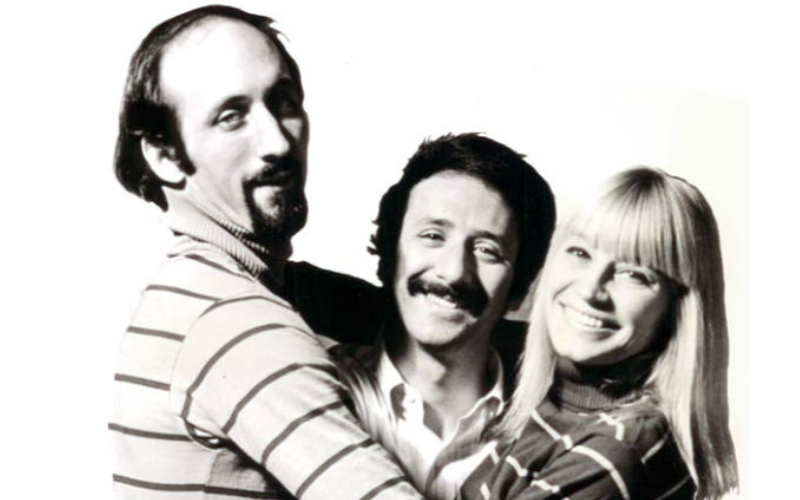
Peter, Paul, and Mary were formed in New York in 1961 when the folk revival was at its height. They were Peter Yarrow, Paul Stookey, and Mary Travers. They took their early material from Folk Music standards, as most artists did. There weren’t many great Folk singers at this time writing their own songs. But Joan Baez did, and so did Bob Dylan.
Peter, Paul, and Mary even covered some songs by Dylan, including “Blowin’ In The Wind”, and “Don’t Think Twice It’s Alright”. Both were released in 1963, the same year as “Puff the Magic Dragon”.
From the early to mid-60s, they were very successful…
The “Puff the Magic Dragon”, entitled Peter, Paul, and Mary, was released in 1962. Subsequently, it stayed at the top of the American Album charts for weeks.
That gave the folk revival more impetus. And it could be argued that brought the likes of Dylan and Baez into the mainstream from purely Folk Music circles.
Do They Still Sing The Song?
Mary Travers died in 2009, but Stookey and Yarrow still perform as a duo under their own names. They took up the mantle of social commentary through Folk Music in the 60s, and it never really left them.
The Song And A Fortuitous Background
It can’t be disputed “Puff the Magic Dragon” is one of the greatest children’s folk songs we have. Yet, the idea that it would become what it did was not present at any level in its creation as a song.
Ogden Nash
Nash was an American poet who, in 1936, had written a poem called “The Tale Of The Custard Dragon.” It was read by a Cornell University student in New York, 19-year-old Leonard Lipton.
He loved the idea of the story but was convinced he could write something similar about a fictitious dragon, but better. That was a bold claim from a Physics student.
Luck Played Its Part
He shared a room with another student, Peter Yarrow, who owned a typewriter, and Lipton began to write his story using it. Peter Yarrow found Lipton’s poem on his typewriter and used it as the base for the story of his song.
He changed the name of the dragon to ‘Puff’ and wrote: “Puff the Magic Dragon”. That was 1962, and one of the most memorable children’s songs ever was born.
The poem was a story about a flying serpent who lived a long way away by the sea. A place called in the poem “Honah Lee.” The story indicates the dragon liked to have fun but was possibly quite lonely. By the time Yarrow had become one of the founder members of Peter, Paul, and Mary, he already had the finished song.
A Nice Touch
The music world, as anyone who has worked in it will know, is packed with the wrong sort of people. Greed and self-interest are often the driving forces.
How nice it is then to see that Yarrow gave his former roommate, Leonard Lipton, a writing credit when the song was released. Did he appreciate that? Did it make a financial difference for him? We shall come back to that a bit later on.
The Song’s Release
It was included on Peter, Paul, and Mary’s debut album but wasn’t the first single released. “Lemon Tree” was their debut single, and it reached #35 on the American chart. That was followed up with the Pete Seeger song, “If I Had A Hammer”. That song began to establish them and went to #10 in America and also did quite well in Australia and Canada.
The next two singles, though, “Big Boat” and “Settle Down,” didn’t do much commercially. “Puff the Magic Dragon” was the third single from the album and was the next single released. It had been a popular addition to their stage set, so they thought it would do well. Here is the live version from 1965.
You could say it was the song that changed everything. It was an instant success and reached #2 on the American chart and was a Top 10 song in four other countries.
A Big Surprise
I don’t think there were too many people at the time that could explain its success. It wasn’t heavily promoted, and there were no big marketing campaigns. The group later said they think it was successful because people liked the dragon. And, of course, they felt very sorry for him.
For the next 40 years, there were books, cover versions, and in 1978 even a film. As recently as 2007, publications were still being made. For example, a children’s book published in France called “Puff the Magic Dragon.” The success of what was a children’s song has been staggering.
Let’s Dispel a Rumour
Before we get to talking about the meaning of Peter, Paul, and Mary’s “Puff the Magic Dragon”, let’s just clear the decks about one attempt at explaining it.
There seems to be some 60s commentary that says “Puff the Magic Dragon” was all about drugs. We are assuming to take that meaning seriously; we must all think it is okay to market drugs through a children’s story. Really?
I cannot ascertain where that idea came from…
But, I think we can assume the reasoning was seen through some marijuana-induced haze that someone must have walked through one day. At the time, there was plenty of it around.
The song title was euphemistic about smoking weed, they claimed. They also said that the boy, Jackie Paper, was referring to ‘rolling up’ the said weed in cigarette papers. The aroma must have been hanging heavy in the air that day.
“Puff the Magic Dragon” was never about smoking weed. And it was certainly not an encouragement for young people to try it out. As Cornell rightly says, the vast majority of kids at the colleges were more interested in the next college dance than lighting up joints.
Who Is This Roaring Dragon?
He is at once a scary monster but also a loving, devoted friend. He is a brave animal that protects Jackie Paper, but he also loves to play and have fun. The archetypal imaginary friend, as most child psychologists would agree. Essentially, the song is about a little boy and his imaginary friend, who manifests himself as a dragon.
Parallels With Other Stories
There are some parallels with another famous children’s story written by Scottish writer Sir James Barrie, Peter Pan. But none of the characters are the same, if some of the inferences are, and Lipton’s words are not describing’ that’ little boy.
There is a fundamental difference between the two stories anyway. Peter Pan is a boy who never grows up. Jackie Paper does grow up and leaves his dragon friend. And therein lies the meaning of the song.
The Meaning Behind “Puff the Magic Dragon” by Peter, Paul, and Mary
In my view, there are two reasons the song was and still is so successful. Let’s quickly look at both.
Lost Youth
There is a point in every person’s life where the games and belief systems held as a child just go away. It’s almost like a puppy or a kitten opening its eyes for the first time.
Our childhood is innocent and surrounded by dreams and hopes, and that innocence eventually becomes lost. As adults, we are sympathetic toward that occurrence. We may even remember the moment it happened. But, it is something we can remember from the past and our younger days. That loss of innocence is what we see Jackie Paper go through.
As the song says, Dragons may live forever, “But not so little boys.” He finds other toys, meaning other activities and interests take over, and the inevitable happens as one day, “Jackie Paper came no more.”
We Feel Sorry For Puff
The second reason may be the listeners’ relationship with Puff. We feel sorry for him because we like him. And at the end of the song, we see him realize that his lifelong friend is not coming to play anymore, and he “sadly slipped into his cave.” The ultimate broken heart.
It is a bit of a weepy with no way out for the listener. Jackie has gone, and Puff is on his own. That has a marked effect on the listener and is one of the reasons the song is elevated to iconic status.
And Today?
Leonard Lipton went on to become a successful filmmaker. He also patented certain equipment he created for making films in 3-D. He created special eyewear for stereoscopic viewing, for which he received an award.
Thanks, Puff!
I mentioned earlier that Peter Yarrow gave Lipton, his former roommate, writing credit for the song. We asked if he had appreciated it and whether it made a difference to Lipton’s life.
I think it is safe to say that he more than appreciated his friend’s kind gesture. Even today, the royalties still roll in. He admitted when asked about it that “Puff” had funded much of his early research work on electronic stereoscopic displays. He would probably say thanks to Puff and certainly would to Peter Yarrow.
Want to Learn the Meaning Behind Other Famous Children’s Songs?
Well, check out our thoughts on The Meaning Behind the Traditional Song, “London Bridge Is Falling Down” and the Meaning of “Ring Around the Rosie” Song Lyrics for more insights.
Also, you might enjoy learning about some Funny Songs to Sing with Kids, Easy Piano Songs for Kids, the Best Kids Dance Songs, and Fun Music Activities For Kids.
Of course, hearing those songs will help. So, check out our reviews of the Best Bluetooth Speakers with Light Show, the Best Wireless Outdoor Speakers, the Loudest Portable Bluetooth Speakers, the Best Waterproof Speakers, the Best Solar Powered Bluetooth Speakers, and the Best Bluetooth Speakers with Alarm Clocks buy in 2024.
The Meaning Behind “Puff the Magic Dragon” by Peter, Paul, and Mary – Final Thoughts
Six decades. That is how long it has been now since we first heard this song. And it is still being asked for. On the 25th anniversary of its release, a special concert was organized. Here is the live version 25 years on. I think it is safe to say that it will always be with us. And one of the reasons for that is the meaning behind “Puff the Magic Dragon”.
Until next time, happy listening.
