

Before I start to discuss the meaning of “Ring Around the Rosie” song lyrics, let me just make a couple of points that I think are important and relevant.
Different Texts
Firstly, this is an English nursery rhyme. So, I will be largely sticking to the meaning of the English “Ring a Ring o Roses” nursery rhyme. Although, I will mention other lyrical amendments that exist. One of which is “Ring Around The Rosie.” Secondly, let’s just look at derivation.
When Did We First See The Song?
Some people claim the song had a much later derivation than its assumed link to the Bubonic Plague in London in the 1600s. To justify this view, they claim that the first written transcript of the song may have come in the 1800s. Therefore, it must have come from that period.
This is a very naive and ill-informed assumption. The song was sung largely by street kids in the 1600s but was also known to their parents and families. But, as only about 10% of the English population was literate at that time, it is not likely it would be written down. It became an oral tradition passed down through the years.
Therefore, no evidence exists, as claimed by some, that it can be dated to the 18th century. Other than that, it was first written down in that period. It became a song that was written down in the 1800s when the literacy level had risen. By then, it was being taken by immigrants leaving the UK for other countries. Sometimes, the words were mistranslated or just misunderstood by the locals, as we shall see.
Oral History
The song and its lyrics would have been passed down through generations and sung largely as it was in its original form. This is known as an oral tradition. Oral is a translation of the Latin word for mouth. A modern-day example of an oral tradition being ‘modernized’ is the song “Scarborough Fair,” recorded by Paul Simon.
Simon spent time in the UK in the early part of the 60s and came across the song. It was a folk tune handed down orally since the market’s inception in the 14th Century. Then, it was written down at a later time. Not dissimilar to our subject matter here.
The song is about a huge market that was held in the Yorkshire town of Scarborough every year. It left a lasting impression on locals and even people from further afield. Similarly, the Bubonic Plague left a scar on the English countryside, particularly in London. The song was passed down through generations both as a reminder and a warning.
Lyrical Anomalies
In some places, the original words of “Ring Around the Rosie” have been altered. This might be accidental, or it might be deliberate for some reason. For instance, there is a line sung in its original format, “Atishoo we all fall down.” That has been altered in some places to be “Ashes, we all fall down.”
The latter description seems a bit nonsensical in that if ‘ashes’ is referring to burning the body after the victim’s death, how could the ashes ‘fall down’?
It is more likely that the word ‘atishoo’ was misheard and may have been a word that was not understood by the people in a new area. They just thought maybe it was ashes and used that alliteration instead.
The Derivation
The meaning behind “Ring Around the Rosie” is most likely related to the Bubonic Plague of the 17th century. And possibly even its predecessor, the Black Death or Black Plague. There are specific references in the lyrics that support this. That said, let’s look at the lines and discuss the meanings of “Ring Around the Rosie.”
At this point, we should remember that because it was not written down, the exact wording will never be known. Not without Dr. Brown and his DeLorean, anyway. And, I doubt there will be many takers to volunteer to go back and witness this piece of history.
What is the Meaning of “Ring Around the Rosie” Song Lyrics?
One interpretation of the line “Ring o Roses” is regarding a symptom. In some cases, not all, there was a first clear indication that a person was infected. This was sometimes described as a red rash with a slightly paler center and dot-like marks around the edges. Thus resembling a rose.
An alternate version exists, which may be of 18th-century French derivation, and refers to “Ring Around The Rosie. A child is picked alternately to be at the center of the circle, usually as a penalty for being slow in the dance.
The other children would hold hands and dance around them in a ring. They are then known as the ‘Rosie’ from the French word “rosier,” meaning rose tree or bush. This then allows the wording of “Ring around the Rosie.”
Why The Pocket Full of Posies?
There are two potential meanings for “Pocket Full of Posies,” and both have some value in their accuracy.
The Stench of Decay
The smell of the dead and dying must have been overpowering. Things were a little different in those days. And, the cries from the street to “bring out your dead” must have been a blessed relief to some to get rid of the smell.
People would carry around any flower that smelled sweet to relieve the stench. Posies of flowers, especially roses, might have given some relief.
That might indicate the reference to posies…
Another was that London’s Mayor at the time ordered large bonfires to burn for three days. Anything that would burn was put on the flames. The smell of the dead was replaced with a thick black choking smoke. Not the brightest of ideas.
To try and offset the stench of decay and noxious smoke, people placed any flowers they could find in their houses. Some believed that sweet-smelling herbs were a prevention, if not a cure, so they burned them inside as part of a fumigation process. Having a pocket full of sweet-smelling flowers would have been a common sight, especially with children.
Atishoo, Atishoo
One of the final symptoms that often occurred was some sort of respiratory failure. This is often referred to as a sneeze, hence the “atishoo. atishoo”.
But, hundreds of years can alter words, and to a largely illiterate population, sneezing or a cough might have meant the same thing. That is especially the case if the cough or sneeze is a particularly violent burst of activity.
There are cases recorded where a sneezing fit was one of the last symptoms before death, but not in every case. However, we must remember this song has been passed down through oral traditions for hundreds of years. So, it would be unreasonable to assume that these words are the same as what was originally sung.
We All Fall Down
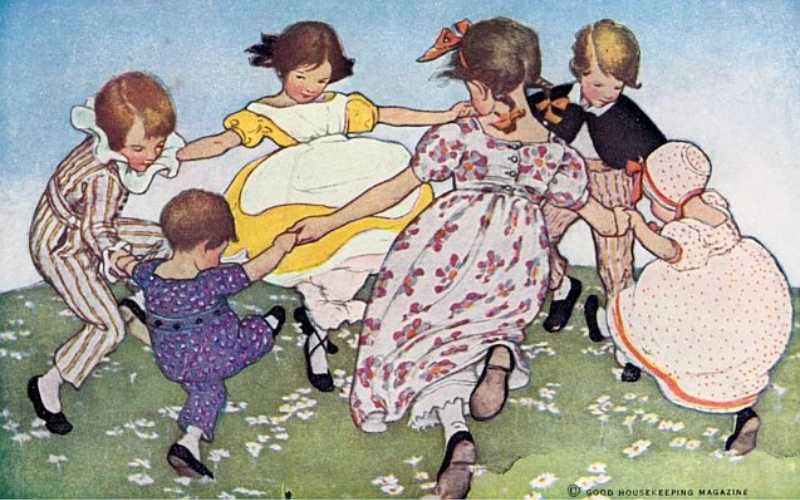
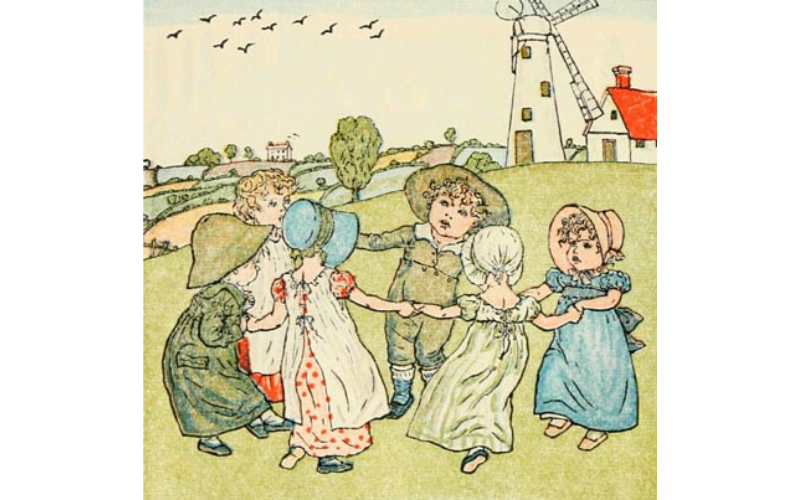
This is the easiest part of the nursery rhyme to comprehend. The children moving around in a circle all fall down when they sing this line. Not hard to imagine what they are simulating and how it relates to the meaning behind “Ring Around the Rosie.”
Why A Nursery Rhyme At All?
Of course, back then, there were no nursery rhymes as we know them today. Children sang songs, but there were no books or music to get them from. Therefore, they were created about things they knew about.
The Plague, Great Plague, or the Black Death was something they would have been very familiar with. People automatically think of the plague as being something that happened in 1665/6 in London.
But that isn’t the case…
This wasn’t a sudden new phenomenon as COVID was. The plague in Europe arrived in 1347. By then, it was rampant in China, India, Egypt, and Persia. It had largely ceased by the 1350s, but every hundred or so years, it reappeared for centuries.
This period was commonly referred to as the ‘Black Death.’ The Great Plague of London in 1665 was sometimes referred to by the same name. That period is more accurately referred to as the Bubonic Plague.
The Mayor Got His Fire Alright
This latest plague was at its worst in London in 1665, which is when many agree the “Ring a Ring o Roses” rhyme probably first appeared. But, it was another disaster for the city that brought that to an end, The Great Fire of 1666.
That destroyed huge swathes of urban London, often in the poorest areas. It also wiped out the Bubonic Plague. It started at a Bakers shop near Pudding Lane on the 2nd of September 1666. The Mayor got his fire. It was the last outbreak of the Bubonic plague in the UK.
Is the Bubonic Plague Still With Us?
While it never came back to the UK, the World Health Organization says there are still between 1,000 and 3,000 deaths attributed to a similar plague every year. This is despite antibiotics that are now available to treat it. Likewise, modern sanitation and cleaner living styles have also helped to largely eradicate it.
Want to Learn About Famous Musicians and Songs?
If so, have a look at our detailed articles on Some Amazing Facts About JS Bach, What Instruments Did Beethoven Play, Amazing Facts About Mozart, Who Invented Music, The Meanings Behind Wade In The Water, and Is Stan Based On A True Story for more fascinating musical information.
Meaning of “Ring Around the Rosie” Song Lyrics – Final Thoughts
Are there no more oral traditions? Sadly, it seems they are slowly vanishing from our cultural experience. True, oral traditions still exist in some parts of the world, but they are steadily being eroded.
That’s unfortunate because oral traditions are an important element in human culture. They give us insight into lifestyles and history as this rhyme has done. And there are plenty of other children’s songs and nursery rhymes with interesting derivations and histories. We are lucky to have them. So, enjoy them while you can.
Until next time, happy listening.
