

Good old-fashioned sticks are fine for bashing the drum kit. But, mallets are the weapon of choice for a whole other range of percussion instruments.
Mallets can be made of a huge range of materials because of the different applications they’re used for. The heads and shafts vary widely, so it’s a good idea to know what each material is good for.
Mallets on Your Drum Kit?
Of course, you can also take mallets onto the drum set to produce a whole different texture from your drums and cymbals. This makes mallets far more versatile than drum sticks.
This is a great reason why mallets should be a part of every drummer and percussionist’s arsenal. So, here’s a comprehensive explanation of what you need to know about mallets.
What Are Mallets Made Out Of?
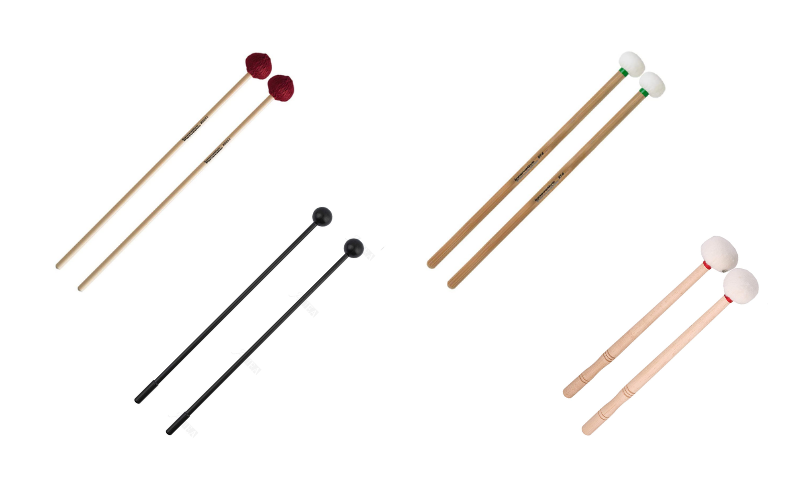
Mallets are sometimes made of a single material. However, it’s far more common to see a different head and shaft material on your mallets. So, let’s look at the most common mallet materials and explain their different qualities.
Shafts
Mallet shafts are typically made out of hardwood; however, this isn’t a hard and fast rule. Because they may not take the sort of beating that drumsticks do, some manufacturers produce shafts from medium density or even softwoods for lighter uses like these mallets from Lovermusic.
However, you will see some alternative mallet materials to wood, like laminated bamboo, rattan, or even plastic.
In general…
Hardwood is a solid and dependable material that works well for most types of mallets. And most drumstick manufacturers use their normal hickory, maple, and oak stock to make mallet shafts as well.
Other materials…
Laminated bamboo can be just as durable for mallet shafts and also makes a more eco-friendly alternative. Rattan, which is a woody tropical vine also used to make furniture, is a specialty shaft material.
It’s flexible, and this makes it well suited for marimba playing, where the percussionist might hold four or more mallets in a Stevens grip. Plastic can either be a cheap, overly flexible material for toy mallet shafts. Or a relatively durable material for things like percussion hammers.
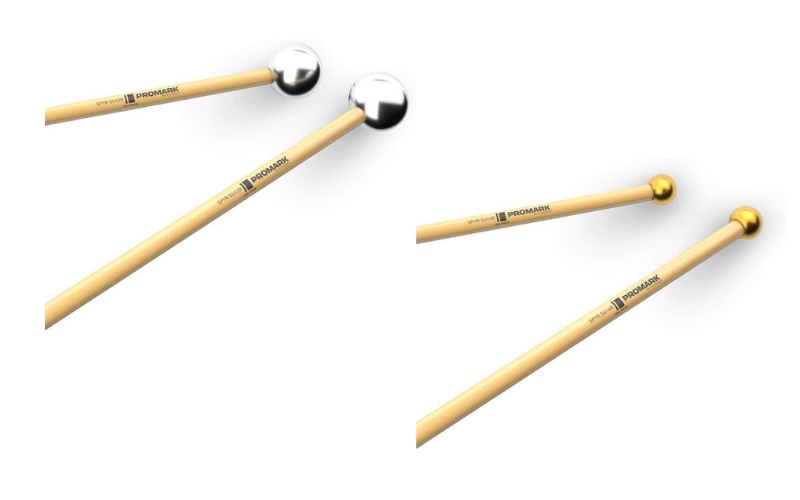
You may also find tough, durable mallet handles made out of aluminum. These can get expensive but will last forever and can be used outside in any sort of weather. Therefore, mallets like these Promarks are often used in marching bands and drum corps.
As for shape…
Mallets are typically either straight or tapered like drumsticks. Some include an extra raised grip area for improved comfort. Great thickness can also improve control for mallets that are used for heavy-hitting, like in marching bands.
Also, mallets may include wrist straps, again for the marchers among us. Both to prevent dropping them and to add coordinated flourishes and spins during performances.
Heads
While the shaft is important, the most crucial part of a mallet is its head. Again, these are made of a multitude of materials for two main reasons.
First, the type of surface you’re going to be striking will limit your choice of head material. You don’t want to damage a surface with a head that’s too hard.
Second, different mallet head materials will produce different timbres in your percussion instruments, and these can be used for different effects.
Common Types of Mallet Heads
Metal heads are the hardest, and this makes them suited for only certain instruments. They’re very loud and extremely bright.
Typically, they’re used on the bells or glockenspiel, and sometimes on tuned cymbals like crotales. Promark is a leading producer and makes them in brass and aluminum heads of different sizes.
Wooden Mallet Heads
Like these ones made from hickory are hard and durable and also fairly inexpensive. They’re generally used for striking harder instruments like the metal keys of a xylophone or glockenspiel. They produce bright and loud sounds.
Plastic Mallet Heads
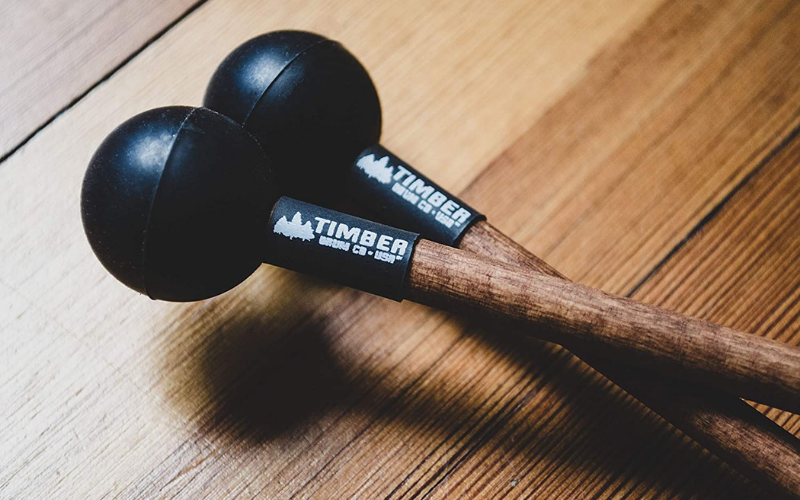
Such as these polymer mallets from Timber Drum Co. are also hard and loud. But, they can be a lot more forgiving on softer materials.
This makes them useable on both the metal keys of xylophones as well as wooden instruments like wood blocks. They’re also relatively cheap, being made out of the world’s favorite disposable material.
Rubber Mallet Heads
These are used on a lot of metal instruments to give a firm strike but a more muted sound with less attack. These Timber Drum Co. rubber mallets could be used with cymbals, xylophones, and even tongue drums or hand pans to allow them to ring out proudly.
Felt Mallet Heads
Generally used on drum heads. Hard-packed felt gives a sturdy whack, but a dull sound to allow large diameter drums to sing out proudly. Felt heads like these Vic Firths are used for timpani, toms, and even bass drums.
Foam Mallet Heads
These are few and far between. They create a very muted sound that can be compared to a soft felt. You’ll sometimes find heads like these on bass drum mallets.
Wrapped Mallet Heads
The last kind of mallet heads. These use cord or yarn wrapped around a hard core (usually of felt) to produce heads that are harder and more durable than just felt alone. Cord is a bit more solid than yarn and produces a slightly louder sound, such as in these Promark cord-wrapped mallets.
Yarn-wrapped mallets like these ones from Mr. Power give you a softer sound that takes away a lot of brightness from metal and wood instruments. Both of these wrapped mallet heads can be used with a variety of instruments, from the marimba to cymbals and even drums.
Head shape is also an important consideration. Round heads give you less attack and a dull, more distributed sound. Flat heads provide less surface area for strikes leading to increased attack and a more concentrated sound.
Which Mallets to Choose?
The mallets you choose depend on both the instrument you want to play with them and the qualities you want to bring out. In general, brighter sounds come from harder mallet heads. While deeper, bassier sounds come from softer mallets.
Let’s look at some of the typical mallet-struck instruments in an average orchestra to see what kinds of mallets percussionists usually use with them. After all, it’s probably one of the most important aspects of what you need to know about mallets.
Big Drums (Timpani, Bass)
Big drums like the bass drum or the tunable timpani, aka kettle drums, are normally struck with felt-headed mallets. Hardwood shafts give you good control, and the felt heads get a lot of contact with the big drum heads to bring out their deep bass notes.
Bass drum mallets are usually big and meaty, like the beater of a kick pedal. You’d normally want to use a medium-hard pair of felt mallets for most playing. However, you could use a softer felt for legato playing, and a harder felt for staccato, as needed.
Other Drums (tenor drums, toms)
While drums are normally hit with sticks, you can use mallets to get louder and more robust tones out of them. Some drum corps use rubber or plastic-headed flat mallets to enhance the volume of their tenor drums.
But, you can also go the opposite direction and use softer mallets, like yarn-wrapped felt on toms, to reduce attack and bring out their fullness.
Cymbals
Mallets are often used on cymbals in orchestral music and, occasionally, in more popular styles. For explosive brightness on tuned cymbals, some players use metal-headed mallets. Although, these can do some damage if not used correctly.
To make cymbals really ring out, rubber or cord-wrapped mallets can be used. You can do a steady roll on a big cymbal to create a huge, loud wash for a great effect.
Xylophone
The xylophone is a percussion instrument made of tuned bars of wood or, more common these days, fiberglass. Because of the softer bars, you wouldn’t want to use wooden or metal.
Instead, the xylophone is normally struck with hard plastic for more attack. Or rubber mallets for a more robust sound.
Marimba
The marimba is a wooden bar instrument like the xylophone but tuned softer. It’s designed to have a less aggressive and more singing sound. For this reason, it’s better to play the marimba with yarn or cord-wrapped mallets, which bring out its character perfectly.
Many players will hold two or even three mallets in each hand in a Stevens grip. If you used hardwood mallet handles, you’d get a lot less flexibility, and it would be harder to strike multiple bars at once. So, for this reason, flexible Rattan handles are preferred.
Vibraphone
The vibraphone is like a metal xylophone but with a damper system to control the ring of the bars. Once again, this instrument is normally played with wrapped mallets. And, since four or even six sticks can be used at once, Rattan shafts are again the best choice.
Bells/Glockenspiel
The orchestra bells, aka glockenspiel, is a straight-up metal bar xylophone. Unlike the vibes, the bells are meant to ring out brightly and loudly. Most players will choose to use metal-headed mallets (in brass or aluminum), wooden, hard plastic, or even rubber.
In this order, they give decreasing attack and brightness. There’s no real way to control the timbre of the instrument itself, so it’s all about the mallets.
Tubular Bells
The tubular bells are an orchestral instrument that produces huge, full bell sounds. In the past, they were normally struck with rawhide hammers, which gave a nice full ring without damaging the bells.
However, these have been almost entirely replaced by cheaper and more durable plastic-headed hammers, like these Chalkin hammers. They need a firm, heavy mallet with a head that’s not hard enough to ruin the bells.
You can hear an assortment of percussion instruments played with different mallets (timpani, glockenspiel, and tubular bells) in the epic progressive rock opus Tubular Bells by Mike Oldfield.
Now You Know What you Need to Know About Mallets
That’s about it for mallets. While the heads and shafts may vary in material and shape, they all have their specific uses that make a lot of sense. The softer the surface you’re going to strike, the softer your heads should be, and vice versa.
And different instruments played with different mallets can sound a whole lot different. This mainly depends on whether you want to focus on attack or a more muted timbre.
Mallets aren’t normally any more expensive than drumsticks, unless you’re looking for a real specialty pair. So, why not pick up an assortment and try them out on various percussion instruments or even your drum set?
Until next time, may the beat go on.
